
From Simulation to Reality: How AXIS 3D Is Helping Advance Physical AI and Sim2Real for Humanoid Robots

Humanoid robots, Physical AI, and Embodied AI have quickly become some of the most influential areas in artificial intelligence. As generative AI, large language models (LLMs), and robotics continue to evolve, AI is moving beyond understanding digital information toward interacting with and operating in the physical world.
Building robots that can perceive, reason, and manipulate objects with human-like capabilities, however, remains a significant technical challenge. Developers must collect high-quality training data, shorten development cycles, and ensure that AI models trained in simulation can perform reliably in real-world environments. Solving these challenges has become one of the industry's highest priorities.
To share practical approaches to this transition, AXIS 3D was invited to speak at the "Future in Motion: AI Robotics Technologies and Industrial Applications" seminar hosted by the Precision Machinery Research & Development Center (PMC). During the event, Technical Manager Chin-Tang Lai presented "From Simulation to Reality: Reinforcement Learning and Motion Generation Solutions for Humanoid Robots," demonstrating how Physical AI, Sim2Real, and motion capture technologies can be combined into a complete training pipeline for next-generation humanoid robots.
The Global Humanoid Robot Market Is Entering a Turning Point
During the seminar, Chung-Hung Huang, Manager at the Industrial Technology Research Institute (ITRI), shared his insights into the latest developments shaping the global humanoid robotics industry.
Robotics has evolved rapidly over the past decade—from traditional industrial robot arms and six-axis manipulators to autonomous mobile robots (AMRs), quadruped robots, and now humanoid platforms. Industry analysts increasingly view 2026 as a pivotal year, when humanoid robots are expected to transition from pilot deployments toward larger-scale commercial production.
Leading robotics companies in the United States and China have already announced production targets ranging from several thousand to tens of thousands of humanoid robots. Against the backdrop of global labor shortages, humanoid robots are widely regarded as one of the next major intelligent computing platforms with significant long-term growth potential.
At the same time, the intelligence behind these robots is evolving just as quickly.
Traditional rule-based control systems are giving way to Vision-Language-Action (VLA) models, enabling robots to interpret visual information, understand natural language, and execute physical actions within a unified AI framework. Combined with World Models, these systems allow robots to build an internal understanding of how the physical world behaves before interacting with it.
As VLA models continue to mature, the industry's competitive focus is gradually shifting. Hardware performance alone is no longer enough. Success increasingly depends on high-quality training data, scalable AI training workflows, and reliable deployment from simulation to the real world. This shift is one of the key reasons why Sim2Real (Simulation-to-Reality) has become a central technology in modern robotics development.
Why Sim2Real Has Become the Foundation of Physical AI
Training AI directly on physical robots is both expensive and time-consuming. It also introduces risks such as hardware wear, unexpected failures, and safety concerns during repeated experimentation.
For these reasons, most humanoid robot developers now rely on a Sim2Real workflow. Instead of learning directly on physical hardware, AI models are first trained in highly realistic simulation environments that accurately reproduce the physics of the real world. Once the models have achieved satisfactory performance, they are deployed to physical robots for validation and real-world operation.
This approach allows developers to iterate much faster, evaluate thousands of scenarios safely, reduce development costs, and significantly improve training efficiency. As a result, Sim2Real has become one of the foundational technologies driving the advancement of Physical AI.
Simulation alone, however, is only part of the equation.
Training robust AI models also requires large volumes of high-quality human motion data. This makes motion capture (MoCap) and data collection essential components of the entire development pipeline, providing robots with realistic demonstrations that can be used for imitation learning, motion generation, and reinforcement learning.
AXIS 3D Delivers an End-to-End Integration Solution for Humanoid Robotics
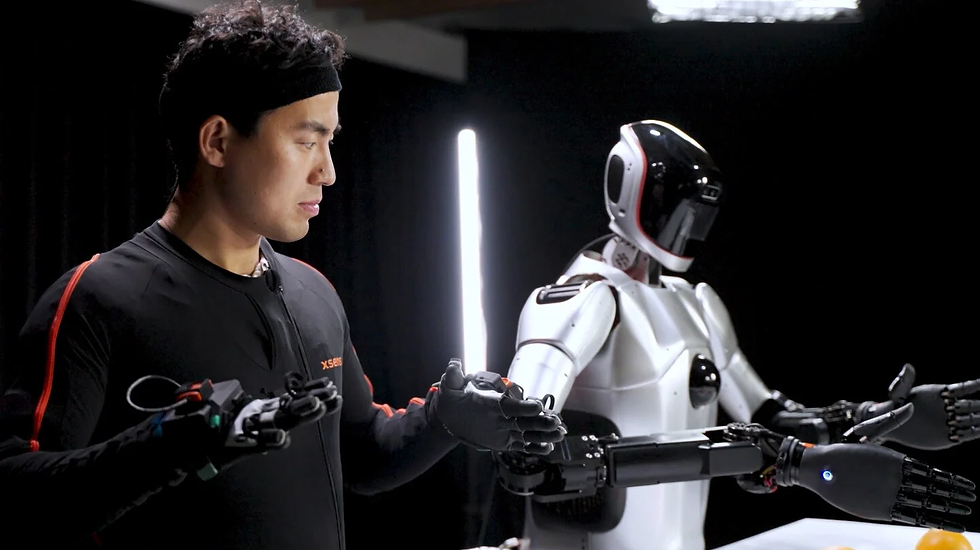
Rather than focusing on a single hardware product, AXIS 3D provides an integrated ecosystem for humanoid robot development. By combining motion capture, simulation platforms, AI training workflows, and system integration, the company helps enterprises, research institutes, and universities build a complete pipeline—from data collection and AI model training to real-world robot deployment.
Its humanoid robotics solutions currently include:
Solution | Application |
Xsens Full-Body Motion Capture | Capture high-quality human motion, posture, and locomotion data for AI training and imitation learning. |
MANUS Metagloves | Record precise finger joint movements and grasping motions to create training datasets for dexterous robotic hands. |
ROS 2 Integration | Connect sensors, controllers, AI models, and robots within a unified robotic software framework. |
Unity & Unreal Engine | Build digital twins, simulation environments, and interactive visualization applications. |
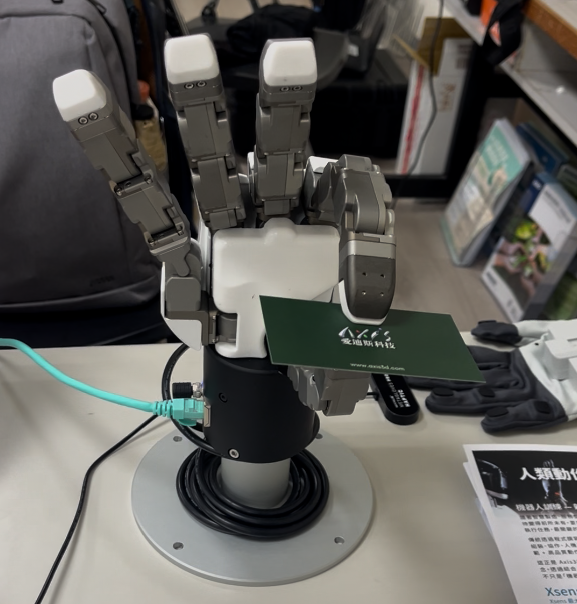
Tesollo DG5F Dexterous Hand | Enable high-DOF grasping and force-feedback capabilities for advanced manipulation tasks. |
NeoCore AI Markerless Motion Capture | Use AI vision to capture human motion without markers, accelerating Real2Sim2Real development workflows. |
By integrating these technologies into a single development workflow, AXIS 3D helps organizations shorten development cycles, reduce system integration complexity, and build scalable Physical AI solutions for real-world applications.
From Human Demonstration to Robot Deployment
During the seminar, AXIS 3D also presented a practical workflow for training humanoid robots.
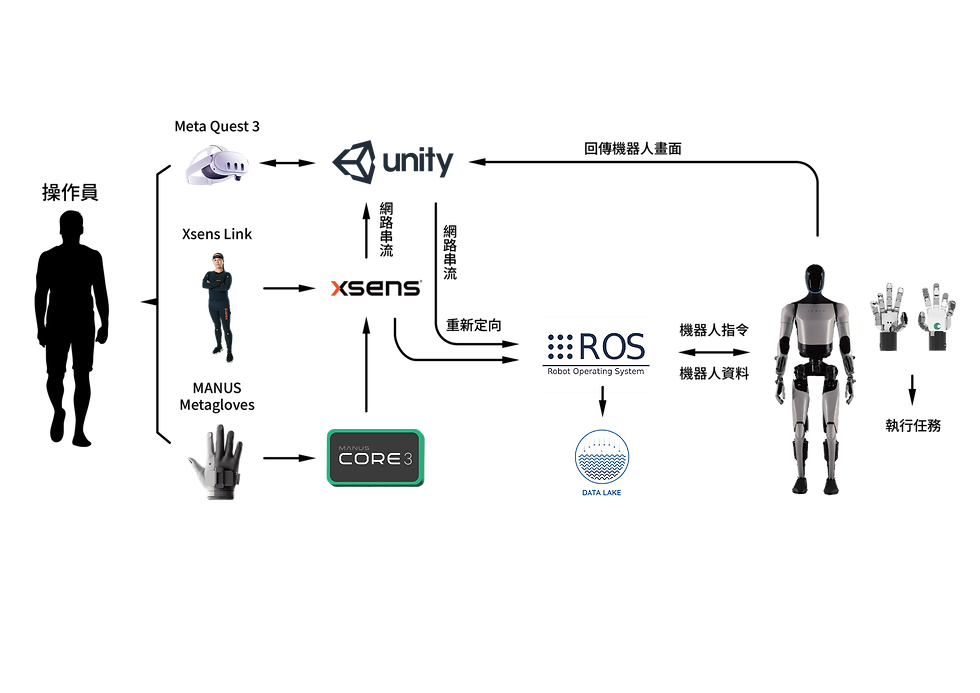
The process begins with a human demonstrator performing tasks such as walking, object handling, or grasping. These movements are captured using the Xsens full-body motion capture system together with MANUS Metagloves, generating high-quality motion datasets for robot learning.
The collected data is then transferred into NVIDIA Isaac Sim, where realistic physics simulations enable large-scale reinforcement learning, motion optimization, and task validation before deployment.
Finally, ROS 2 integrates perception systems, controllers, AI models, and robot hardware into a unified framework, allowing trained models to be deployed on physical humanoid robots.
The complete development pipeline can be summarized as:
Human Demonstration → Motion Capture → Simulation → Robot Learning → Real-World Deployment
This workflow supports a wide range of applications, including:
Teleoperation
Imitation Learning
Hazardous Environment Operations
Smart Manufacturing
Academic Research
Service Robotics
By combining simulation with real-world motion data, developers can train robots more efficiently while minimizing hardware risks and accelerating deployment.
Taiwan's Opportunity in the Physical AI Era
Another key topic discussed during the seminar was the changing landscape of global competition.
Rather than competing solely on individual products, the next wave of innovation will be driven by complete technology ecosystems that integrate AI models, robotics, simulation platforms, and data infrastructure.
Taiwan is well positioned to contribute to this transformation. With strengths in semiconductor manufacturing, AI computing platforms, electronics, and system integration, the country has the technical foundation to play an important role in the emerging Physical AI supply chain.
Instead of competing directly in the highly crowded general-purpose robotics market, Taiwan has the opportunity to focus on specialized applications in industries such as semiconductor manufacturing, smart factories, healthcare, education, and precision engineering—areas where domain expertise and system integration create greater long-term value.
Accelerating the Adoption of Physical AI
Looking ahead, AXIS 3D will continue investing in Physical AI, Embodied AI, and humanoid robot integration technologies. By combining motion capture, simulation-based training, AI model development, and ROS 2 integration, the company aims to help organizations establish complete development pipelines—from Human Demonstration and Simulation to Robot Learning and Real-World Deployment.
As humanoid robotics continues to evolve, competitive advantage will depend on far more than hardware performance. High-quality data, efficient AI training workflows, and seamless system integration will become the key factors that determine how quickly intelligent robots can move from the laboratory into real-world applications.
Together with technology partners around the world, AXIS 3D is committed to accelerating the adoption of Physical AI and supporting the next generation of embodied intelligence across research, education, and industry.

Frequently Asked Questions About Humanoid Robots and Physical AI
Q1:What is Physical AI?
Physical AI refers to AI systems that can perceive, reason, and interact with the physical world through sensors, robots, and control systems. Rather than processing only text or images, Physical AI enables machines to make decisions and perform real-world tasks, making it a key foundation of Embodied AI.
Q2:What is Sim2Real, and why is it important for humanoid robots?
Sim2Real (Simulation-to-Reality) is a development approach in which AI models are trained in highly realistic simulation environments before being deployed on physical robots.
By validating behaviors in simulation first, developers can reduce training costs, shorten development time, minimize hardware wear, and improve deployment safety. As a result, Sim2Real has become a core technology in modern humanoid robot development.
Q3:How is motion capture used in humanoid robot training?
Motion capture records human body movements, hand gestures, and manipulation tasks with high precision, creating high-quality datasets for robot learning.
These datasets are widely used in applications such as:
Teleoperation
Imitation Learning
Reinforcement Learning
Motion generation and robot skill learning
Q4:What humanoid robot solutions does AXIS 3D provide?
AXIS 3D offers an end-to-end integration solution covering motion capture, hand tracking, simulation, AI training, and robot deployment.
Its solutions include Xsens motion capture, MANUS Metagloves, NVIDIA Isaac Sim, ROS 2 integration, Unity, Unreal Engine, and humanoid robot deployment, helping enterprises, research institutes, and universities build complete Physical AI development workflows.
Q5:Which industries can benefit from Physical AI and humanoid robots?
Physical AI is being adopted across a growing range of industries, including smart manufacturing, semiconductor production, logistics automation, academic research, healthcare, hazardous environment operations, and commercial services.
By combining AI with intelligent robotics, organizations can improve operational efficiency, reduce manual workloads, and accelerate digital transformation.


